
How Do You Integrate AI Marketing With Your CRM?
Last Updated: November 10, 2026
Quick Summary
AI marketing CRM integration connects your AI tools to the customer records you already keep, so predictions and personalization run on live data. Start by auditing and cleaning your CRM data, then choose tools by mapping sync direction, identity keys, and field ownership.
- Audit a sample of 200 to 500 contact records for duplicates, missing job titles, and outdated emails.
- Merge duplicate contacts and standardize fields such as industry, company size, and lead source.
- Remove or flag records with no activity in 18 months or more.
- Map each connection’s sync direction, frequency, identity key, and system of record before comparing vendors.
- Test lead scores against last year’s leads and confirm top scorers actually close at a higher rate.
Table of Contents
- What AI Marketing Integration With Your CRM Actually Means
- Preparing Your CRM Data Before Any AI Touches It
- Choosing AI Marketing Integration Tools That Fit Your Stack
- Setting Up AI-Powered Lead Scoring Step by Step
- Automating B2B Customer Journeys Without Losing Human Oversight
- Measuring ROI and Fixing Common Integration Failures
- Booking Your Integration Assessment With Dealey A.I. Strategies
- Frequently Asked Questions
What AI Marketing Integration With Your CRM Actually Means
AI marketing integration with your CRM means connecting your AI tools to the customer records you already keep, so that predictions and personalization run on live data instead of guesses. Read the full guide on integrating AI strategies with a CRM Study on integrating AI into customer relationship management with practical executive guidelines
Most businesses assume this is a software purchase. It is not. It is a change in how your contacts, deals, and campaigns share information, and in who reviews what the AI produces.
The distinction matters because a tool bolted onto a messy CRM simply automates the mess. Clean connections, clear ownership, and a defined goal come first. Done properly, the CRM becomes the single record that feeds scoring, segmentation, and follow-up.
A case study on AI in marketing reported gains in campaign performance, more efficient budget allocation, and better conversion results. Published case study on artificial intelligence in marketing Those gains depend on the data underneath being usable, which is why the next step is always data preparation.
Preparing Your CRM Data Before Any AI Touches It
Start with a data audit. Pull a sample of 200 to 500 contact records and check for duplicates, missing job titles, outdated email addresses, and inconsistent company names. Check whether your data and systems are ready for AI with a readiness assessment
Watch out: an AI model trained on duplicate and incomplete records will score the same prospect twice and miss the real buying signals. Fix the foundation first.
Work through the list in this order:
- Merge duplicate contacts and accounts.
- Standardize fields such as industry, company size, and lead source.
- Remove or flag records with no activity in 18 months or more.
- Confirm that every deal stage has a clear definition your whole team uses.
- Document who owns each field and how it gets updated.
| Data Task | What to Check | Why It Matters for AI |
|---|---|---|
| Deduplication | Repeated contacts and accounts | Prevents double-scoring |
| Field standardization | Industry, size, lead source | Enables clean segmentation |
| Stale record cleanup | No activity in 18+ months | Stops false signals |
| Stage definitions | Shared meaning across the team | Makes outcomes comparable |
Choosing AI Marketing Integration Tools That Fit Your Stack
Most AI marketing tools will claim a CRM integration. Learn whether AI can be added to the CRM you already run The real question is how the connection is built, which system owns each field, and what happens when the two systems disagree. Treat tool selection as an architecture decision, not a feature checklist.
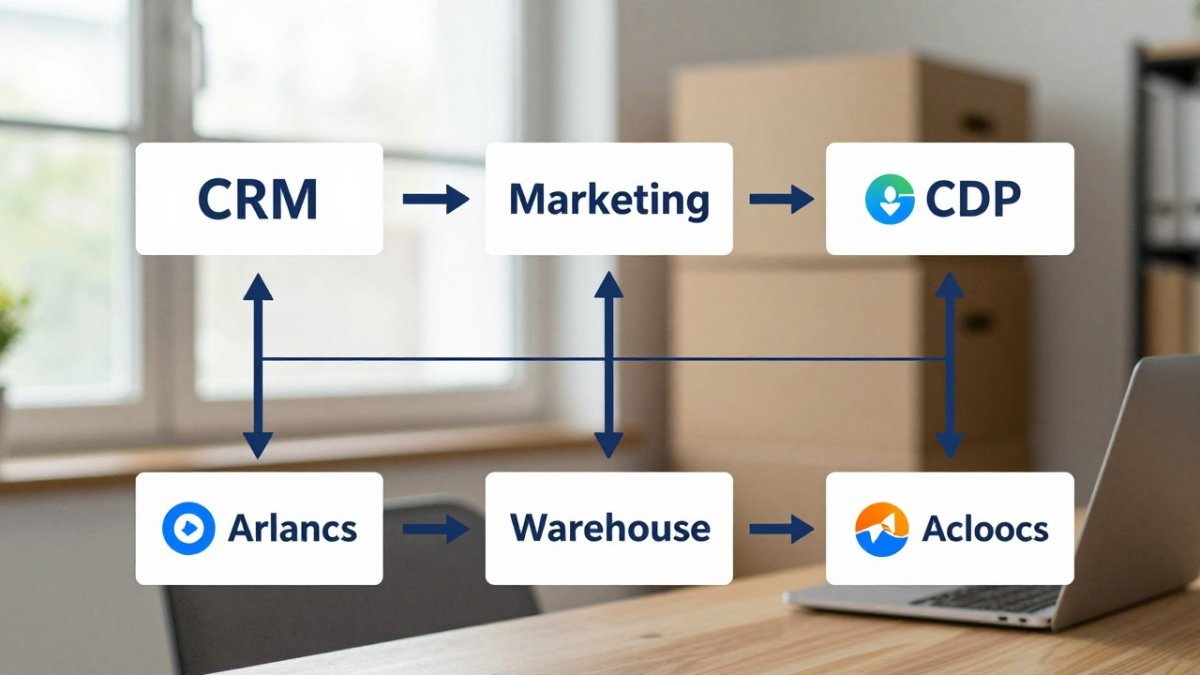
Start by mapping the systems that will touch customer data: your CRM, marketing automation platform, analytics or warehouse, advertising platforms, and any customer data platform (CDP).
Identity resolution is where most marketing stacks break. A prospect may exist as an anonymous web visitor, a form fill, a CRM contact, and an ad-platform audience member. Decide which identifier is authoritative and how the others are stitched to it. Keeping identity stitched across systems also means maintaining brand voice in AI marketing, so personalized messages remain consistent wherever a prospect encounters them.
Sync direction carries real trade-offs. Read-only connections are safer and easier to govern, but they limit personalization because the AI cannot update the CRM with new scores or next-best actions. Bidirectional sync unlocks closed-loop scoring and campaign attribution, but it multiplies the risk of conflicting writes.
Ask every vendor these questions before you shortlist:
- Does it write back to the CRM, and to which objects and fields?
- What is the sync latency, and how are conflicts resolved when both systems change a record?
- How does it handle consent and opt-out status, and does it respect suppression across channels?
- Can you export the model inputs and scores for audit, or is the logic a black box?
- What happens to enriched or scored records if you cancel the contract?
Check native integrations first, then middleware or iPaaS options, and only then custom builds. Native connectors are usually the lowest-maintenance path, but they vary in depth: some sync contacts only, while others sync custom objects, activities, and consent flags. Middleware gives you control over field mapping and transformation but adds an operational dependency. Custom builds are justified only when your data model is genuinely unusual.
A practical rule: choose a tool your team can explain to a new hire in one meeting, and whose data flow you can draw on a whiteboard. Complexity you cannot explain is complexity you will not maintain. Pricing depends on vendor, contact volume, and feature tier, so request a current quote from each provider.
Setting Up AI-Powered Lead Scoring Step by Step
AI-powered lead scoring ranks prospects by how likely they are to buy, using their behavior and profile data. The score is only as good as the signals behind it.
Defining the Signals That Predict a Qualified Lead
Begin with your closed deals from the past 12 to 24 months. Compare the won deals with the lost ones and list the traits they share.
Common signals include:
- Company size and industry match with your best past customers
- Pages visited, such as pricing or case study pages
- Email engagement and meeting requests
- Job title and seniority of the contact
A common mistake is weighting email opens heavily. Opens are noisy, so give more weight to replies and meetings booked.
Testing Scores Against Closed Deals
Before you trust a score, test it. Take last year’s leads, run them through the model as if they were new, and see whether the high scorers actually closed.
If top-scored leads close at roughly the same rate as average leads, the model is not finding real intent. Adjust the signals and test again before routing live leads to sales.
Automating B2B Customer Journeys Without Losing Human Oversight
Automation should handle timing and routine follow-up. People should handle judgment calls, such as a prospect who mentions a budget freeze or a competitor. Explore done-for-you agentic workflows with human checkpoints
Set up triggers that move a contact to the next step when they act, for example after a demo request or a pricing page visit. Then add a checkpoint where a salesperson reviews any high-value account before the next automated message goes out.
Watch out: fully automated sequences to enterprise accounts can damage relationships fast. Keep a named human owner on every account above your deal-size threshold.
Measuring ROI and Fixing Common Integration Failures
Most AI CRM content stops at “track your KPIs.” A measurement framework that survives scrutiny needs a baseline, a test design, and a formula for incremental impact. Without those, you cannot tell whether the AI improved results or whether the quarter was simply easier.
Start by capturing a baseline before the AI tool goes live. Pull 90 to 180 days of history for four core metrics: lead-to-opportunity rate, opportunity-to-close rate, sales cycle length, and cost per closed deal. Segment the baseline by channel, segment, and deal size so you are not comparing enterprise deals to self-serve signups.
Then design the test. The cleanest approach is a holdout: route a random share of leads or accounts through the existing process while the AI-assisted process runs on the rest. If a holdout is impractical, use a matched pre/post comparison on similar segments and state the limitation openly.
For incremental impact, compare the treated group to the holdout rather than to industry averages. A simple formula: incremental conversions equals treated conversions minus (holdout conversion rate multiplied by treated volume). Divide incremental gross profit by program cost to get an incremental ROI figure. Report confidence intervals or at least the sample size, and resist the temptation to declare victory on a two-week window.
Attribution deserves its own line. AI-driven personalization, scoring, and next-best-action often overlap with existing campaigns, so use a consistent attribution model (first-touch, last-touch, or position-based) and keep it fixed during the test. If your CRM supports campaign influence or multi-touch attribution, use it, but document the rules.
Governance is part of measurement, not a separate compliance chore. Build these controls into the marketing workflow:
- Consent and suppression: the AI must read opt-out and consent status from the CRM before any message is sent, and suppression must apply across email, ads, and sales outreach.
- Data minimization: feed the model only the fields it needs; do not pipe sensitive attributes into scoring without a documented purpose.
- Access controls: limit who can view, edit, or override scores, and log overrides so you can audit them.
- Model monitoring: review score distributions and outcome rates monthly for drift, and check for bias across segments such as company size or region.
- Human approval: require a named reviewer for high-value accounts and for any AI-generated message that goes to an enterprise contact.
Failure modes are predictable, and each has a remedy. Scores that salespeople ignore usually mean the signals were chosen without sales input; fix it by co-designing the model with the reps who will use it.
Finally, assign ownership. A named marketing ops owner should review data quality, sync health, and model performance monthly, and report the incremental ROI figure to leadership on a fixed cadence. Integration without an owner quietly rots.
Booking Your Integration Assessment With Dealey A.I. Strategies
If you want an honest read on where your CRM and marketing stand before you buy anything, start with an assessment. Dealey A.I. Strategies offers a 30-minute strategic call.
Book a 30-minute Strategic Call with Dealey A.I. Strategies to get clarity on your current AI standing and a practical next step for your CRM.
Frequently Asked Questions
What are the benefits of integrating AI marketing with CRM?
Integrating AI marketing with your CRM connects campaign activity to actual customer records, so your marketing team can see which prospects engaged, what they did next and how close they are to buying. Teams that do this typically spend less time on manual reporting and route leads faster. The gains depend on data quality, so the integration should start with a clean customer database and clearly defined lead stages. Measure results against your pre-integration baseline for lead response time, qualified lead volume and conversion rate to confirm the benefit in your own pipeline.
How does AI improve CRM data quality?
AI tools can flag duplicate contacts, detect missing fields, standardise job titles and company names, and identify records that have gone stale. Some systems also fill gaps by enriching records from approved data sources. These functions work best after you have set validation rules and chosen which fields are authoritative, because AI applies whatever rules it is given. Review the flagged changes regularly, particularly during the first few months, so errors are caught before they spread through your reporting.
Can AI automate lead nurturing in CRM?
Yes. AI-driven nurturing can trigger follow-up emails, content recommendations and task reminders based on behaviour such as page visits, email opens or a stalled deal stage. The automation should follow rules your team approves, with clear exit conditions so that a prospect who replies or books a call is removed from the sequence. Keep a human reviewing messages for high-value accounts, since automated copy that misreads context can damage a relationship that took months to build.
How do I choose the right AI tools for my CRM?
Start with the workflow you need to improve, such as lead scoring or campaign personalisation, then check whether the tool connects natively to your CRM and marketing platform. Ask for documentation on data handling, consent management and how scores are calculated, so you can explain them to your team. Request a trial using a sample of your own historical data rather than a demo dataset. Pricing varies widely by vendor and usage level, so request a written quote for your specific volume and setup.


niki
Niki is a Certified A.I. Consultant with expertise in Data Science, Architecture, and Implementation, and a Certified Conversion Strategist. Niki has been featured on CNN, FOX, ABC, NBC, and CBC, and was invited to create coursework for Stanford University.
Related posts