
How to Make Business Information Consistent Across AI Search Results
Last Updated: November 17, 2026
Quick Summary
To make business information consistent across AI search results, build one canonical source of truth for your business facts, audit every listing against it field by field, and fix the sources AI systems cite most. Then monitor AI answers monthly and correct mismatches at their cited source until the facts agree.
- A factual agreement score below 90% usually means AI answers will hedge or cite a competitor.
- Only 14% of businesses track AI visibility at all, according to GoodFirms’ 2026 adoption analysis.
- Standardize on one primary phone number with the same formatting everywhere, including country code.
- Re-run the same query after 2-4 weeks and record whether the AI answer changed.
- Assign one owner for business facts and require every listing update to go through the master file.
Table of Contents
- Why Your Business Facts Diverge Across AI Search Results
- Step 1: Build a Canonical Source of Truth for Business Facts
- Step 2: Run a Business Listings Consistency Audit
- Step 3: Use AI Search Monitoring Tools to Establish Your Baseline
- Step 4: Set Up AI Brand Mention Tracking and Brand Mention Tracking Tools
- Step 5: Structure Content So AI Systems Read It Correctly
- Step 6: Correct Inaccurate AI Answers and Prevent Drift
- Book a 30-Minute Strategic Call to Fix Your AI Visibility
- Frequently Asked Questions
Why Your Business Facts Diverge Across AI Search Results
According to GoodFirms’ 2026 analysis of search behavior, 58.5% of searches now end without a click. Your customers get their answer on the results page, and increasingly that answer comes from an AI system summarizing your business.
Here is the problem. When AI systems pull facts about your company, they gather them from many sources: your website, directory listings, review sites, and old press mentions. If you want to understand why traditional SEO fails for AI, that page explains the difference. If those sources disagree on your address, hours, or service area, the AI picks one. It may not pick yours. That is how a business ends up invisible or misrepresented in AI search results, and it is the kind of problem Dealey A.I. Strategies helps businesses assess and repair.
AI search results are the answers AI systems generate and cite from multiple sources rather than a list of blue links. Consistency across those sources is what earns you accurate citations.
How AI Systems Select and Cite Sources
AI models do not browse like a person. They crawl, index, and summarize. An AI system builds its answer from sources it can read easily and trusts most: structured pages, consistent listings, and repeated mentions that agree with each other.
Conflicting facts create doubt. When three sources say one thing and two say another, the model may hedge, omit you, or cite a competitor instead. Research from Semrush’s 2026 enterprise study found that traditional SEO signals remain foundational to whether AI systems surface and cite a business at all.
The fix is not more content. It is agreement.
Step 1: Build a Canonical Source of Truth for Business Facts
A canonical source of truth is one master document that holds your verified business facts: legal name, address, phone, hours, service area, and core offers. Every other listing copies from it.
Create a single internal file. Include:
- Legal and trading names
- Full address and phone number
- Hours, including holiday exceptions
- Services and service areas
- Short and long business descriptions
Then treat that file as law. When a fact changes, you update the master first, then push the change everywhere else. Most divergence starts because someone updated one listing and forgot the other eleven.
Step 2: Run a Business Listings Consistency Audit
Audit your listings before you fix anything. You cannot correct what you have not measured, and most businesses discover that the problem is wider than one wrong phone number.
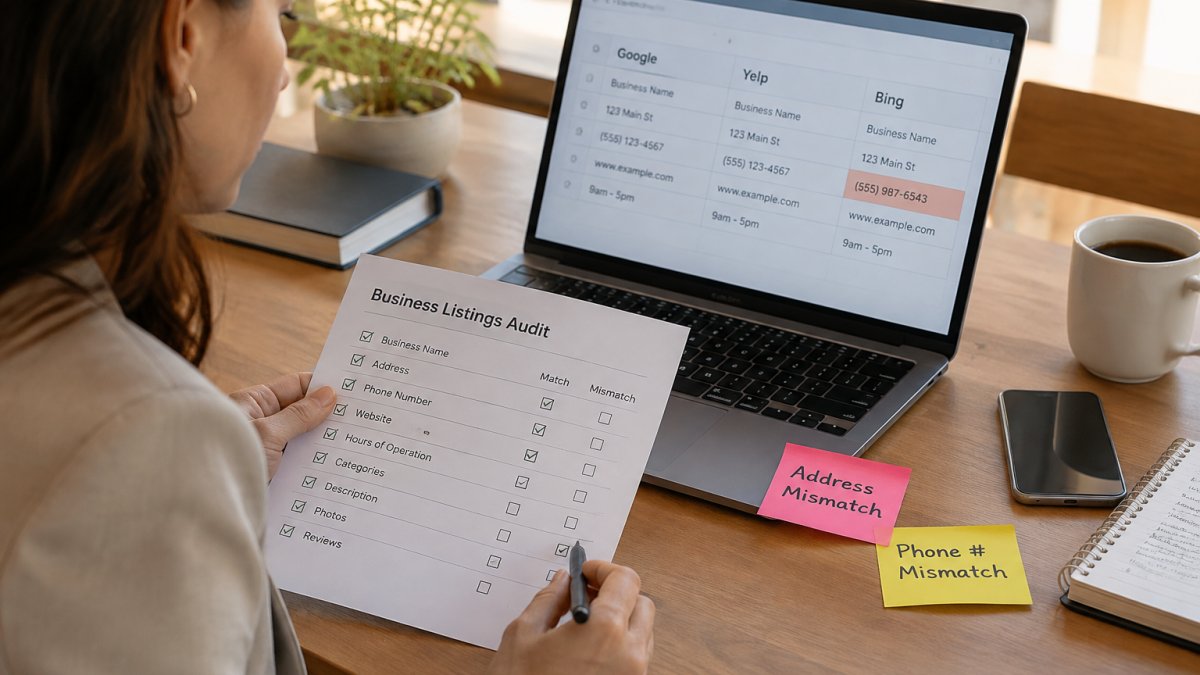
A useful audit compares every source against your master file field by field, not source by source.
Check these sources against your master file:
- Google Business Profile
- Bing Places and Apple Business Connect
- Your website’s contact, about, and location pages
- Major directories and review platforms
- Social media profiles
- Industry-specific and local chamber listings
- Data aggregators and map providers
- Press mentions and old PDFs or brochures still online
Log every mismatch in the same spreadsheet: source, wrong field, correct value, date found, date fixed, and who fixed it. A step-by-step AI visibility audit guide for service businesses walks through this process in detail if you want a structured template.
Prioritize corrections by blast radius, not by how easy they are to fix. A wrong address on Google Business Profile or a major data aggregator propagates to dozens of downstream sites, so it outranks a stale description on a niche directory.
Watch out: the most common miss is the phone number format. One listing shows a local number, another shows a tracking number, and the AI cannot confirm which is real. Standardize on one primary number and use the same formatting everywhere, including country code and separators.
Measure the audit with a simple factual agreement score: divide matching cells by total cells checked. A score below 90% usually means AI answers will hedge or cite a competitor. Re-run the same audit quarterly and after any rebrand, move, or leadership change, because those events are when divergence starts.
Step 3: Use AI Search Monitoring Tools to Establish Your Baseline
You need to know what AI systems currently say about you. AI search monitoring tools query AI platforms and record the answers, so you can see your starting point.
Run the same five questions across ChatGPT, Google AI Overviews, and Perplexity:
- What does [your business] do?
- Where is [your business] located?
- What are [your business]’s hours?
- Who owns [your business]?
- What services does [your business] offer?
Screenshot every answer. That is your AI visibility baseline. Our guide on how to check AI brand visibility step by step shows exactly how to run and record this test.
Only 14% of businesses track AI visibility at all, according to GoodFirms’ 2026 adoption analysis. The other 86% are guessing.
Step 4: Set Up AI Brand Mention Tracking and Brand Mention Tracking Tools
AI brand mention tracking is the ongoing process of monitoring where and how AI systems mention your business. Brand mention tracking tools automate this so you catch drift early instead of after a lost deal.
What to track:
- Which AI platforms mention you
- Whether the facts in each mention match your master file
- Which sources the AI cites for your business
- How often competitors appear in your place
Set a monthly review. Compare new answers to your baseline. Any new mismatch goes straight into your correction log. If you want a shortlist of platforms that handle this, our comparison of the 5 best AI brand mention tracking tools covers what each one actually monitors.
Step 5: Structure Content So AI Systems Read It Correctly
Clean structure makes your facts easy to extract. AI systems reward pages that state facts plainly and back them with schema.
Do these three things:
- Answer first. Put the direct answer in the first sentence under each heading.
- Use clear headings and bullet lists. Short, scannable blocks beat dense paragraphs.
- Add schema markup. Use Organization, LocalBusiness, and FAQ schema so machines parse your facts without guessing.
Adobe’s 2026 industry outlook notes the shift from ranking for links to winning citations in AI answers, which puts content structure and machine readability at the center of the work. Keep your site crawlable and indexable too. An AI system cannot cite a page it cannot read.
Step 6: Correct Inaccurate AI Answers and Prevent Drift
Correction is a workflow, not a one-time task. When you find a wrong fact in an AI answer, trace it to the source the AI cited, fix that source, then re-test. The businesses that recover fastest treat correction as a repeatable process with owners, priorities, and a verification date.
A simple correction workflow:
- Log the wrong answer, the AI platform, the date, and the exact source the AI cited
- Classify the error: wrong fact, outdated fact, missing fact, or conflicting fact
- Fix the cited source to match your master file
- Request an update where the platform allows it, and keep the confirmation
- Re-run the same query after 2-4 weeks and record whether the answer changed
- If the answer did not change, escalate to the next most-cited source and repeat
Prioritize corrections by impact. A wrong address or phone number costs leads immediately and should be fixed the same day. A stale description or an outdated service list can wait for the next monthly cycle. A wrong owner or leadership fact is a trust issue and should be corrected before any marketing push.
Prevent drift with governance. Assign one owner for business facts, and require every listing update to go through the master file rather than being edited directly on a platform. Keep a change log so you can see which facts changed, when, and who approved them. For multi-location or franchise businesses, give each location a fact sheet and audit quarterly, because one stale branch listing can drag the whole brand’s AI answers out of sync.
Measure progress with a small scorecard rather than general AI citation tracking. Track factual agreement (the percentage of audited cells that match the master file), citation accuracy (the percentage of AI answers that cite a correct source), correction time (days from finding a mismatch to verifying the fix), and visibility (whether the business appears in answers for its core questions).
Watch out: correcting a source does not guarantee the AI answer changes on your schedule. Models refresh at different rates, and some answers persist for weeks. While you wait for answers to catch up, keep the verified details in a living record for AI agents so each source can be checked against the same current facts.
| Step | What You Do | Time | How Often |
|---|---|---|---|
| Build source of truth | Write one master fact file | 2-3 hours | Once, then on change |
| Listings audit | Check every listing for mismatches | 3-4 hours | Quarterly |
| Baseline test | Query AI platforms, screenshot answers | 1 hour | Once, then monthly |
| Mention tracking | Review AI mentions vs. master file | 1 hour | Monthly |
| Correction | Fix cited sources, re-test | Varies | As found |
| Governance | One owner, fact sheets per location | Ongoing | Continuous |
Book a 30-Minute Strategic Call to Fix Your AI Visibility
AI systems are already answering questions about your business, and knowing what they are reading is the first step toward influencing what they say.
Dealey A.I. Strategies built the A.I. Visibility Playbook™ to assess and repair your A.I. visibility and help turn it into predictable revenue. The playbook is designed to show you where you stand and to assess and repair your A.I. visibility. Availability is limited by niche and territory.
Get started with Dealey A.I. Strategies and book a 30-minute Strategic Call to see exactly where your business facts stand in AI search results.
Frequently Asked Questions
Why does my business information appear differently across AI search results?
AI systems pull facts from many sources at once: your website, Google Business Profile, directories, review sites, and third-party mentions. When those sources disagree on your address, phone number, hours, or service description, the AI picks one version, and it may not be the correct one. The answer shown on the results page is often the only impression a prospect gets. Fixing the underlying sources is the only reliable way to control what appears.
How often should I check my business information in AI search results?
Run a baseline check first, then re-test monthly for the first quarter and quarterly after that. Monthly checks catch drift after a move, a rebrand, or a new location before it spreads. Pair scheduled checks with alerts from brand mention tracking tools so you hear about a wrong fact from a customer review or directory update rather than discovering it months later.
Can brand monitoring tools track mentions in AI search?
Some can, but coverage varies. Traditional brand mention tracking tools were built for social media and web mentions, not AI-generated answers. When you evaluate AI search monitoring tools, test whether they query AI platforms directly, log the exact answer text, and flag factual mismatches against your canonical record. A tool that only counts mentions without checking accuracy leaves you guessing. Combine tool output with manual spot checks on your highest-value customer questions.
Which business details should be consistent across online sources?
Prioritize the facts AI systems cite most: legal and trading name, address, phone number, website URL, hours, service areas, core service list, and pricing model language. Add certifications, founding year, and leadership names if they appear in your marketing. Write each one in a single canonical document, then update every listing, directory, and profile to match word for word.


niki
Niki is a Certified A.I. Consultant with expertise in Data Science, Architecture, and Implementation, and a Certified Conversion Strategist. Niki has been featured on CNN, FOX, ABC, NBC, and CBC, and was invited to create coursework for Stanford University.
Related posts